 Guppy
Features
What Guppy does, taken from the project’s README and changelog for v1.1.106.
New
The Guppy Blob: dictation into any app
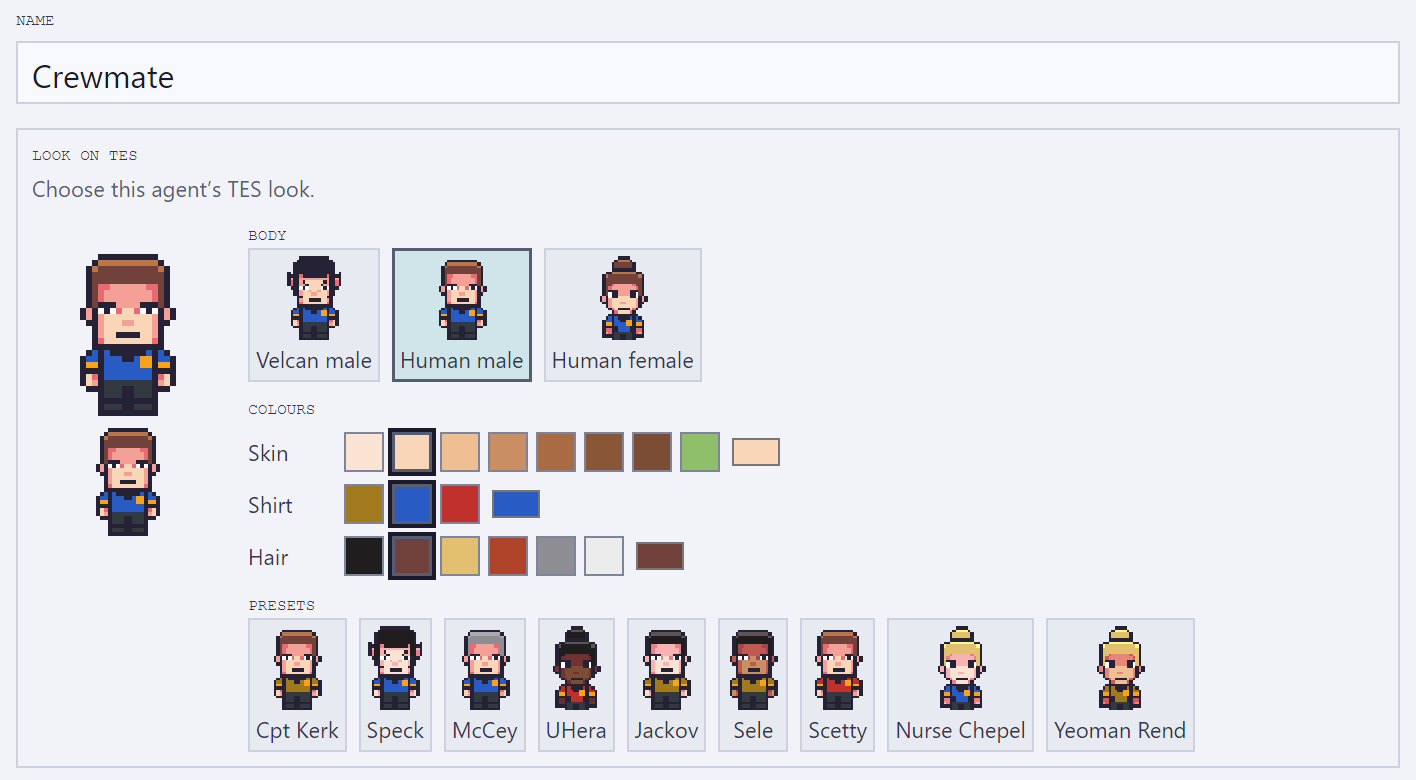
An optional, always-on-top face you can drag anywhere. Hold a hotkey, speak, and your words are typed where you were typing. How to set up your Blob.
- Hold-to-talk dictation (Windows). Hold Ctrl+Alt+Space in any app; the Blob shows it is listening. Release, and the transcript is typed into the field you were in. It never presses Enter.
- If you switch windows before it finishes, nothing is typed and the Blob says so. Clips run from 0.3 s to 120 s.
- It looks around (1.1.106). Its eyes follow the cursor, a hovered ring slot, and the text field while you dictate.
- The ring. Click the Blob: Invisible keeps it out of screenshots, recordings and screen shares (on by default), and Close puts it away. Screenshot, record meeting and record message are shown as coming soon.
- A show/hide hotkey (Ctrl+Alt+G by default). The Blob stays on screen when a monitor is removed or the layout or DPI changes. Off by default.
- Privacy: when you use Blob dictation, your recorded audio goes to Groq for speech-to-text, using your own Groq API key.
Agents
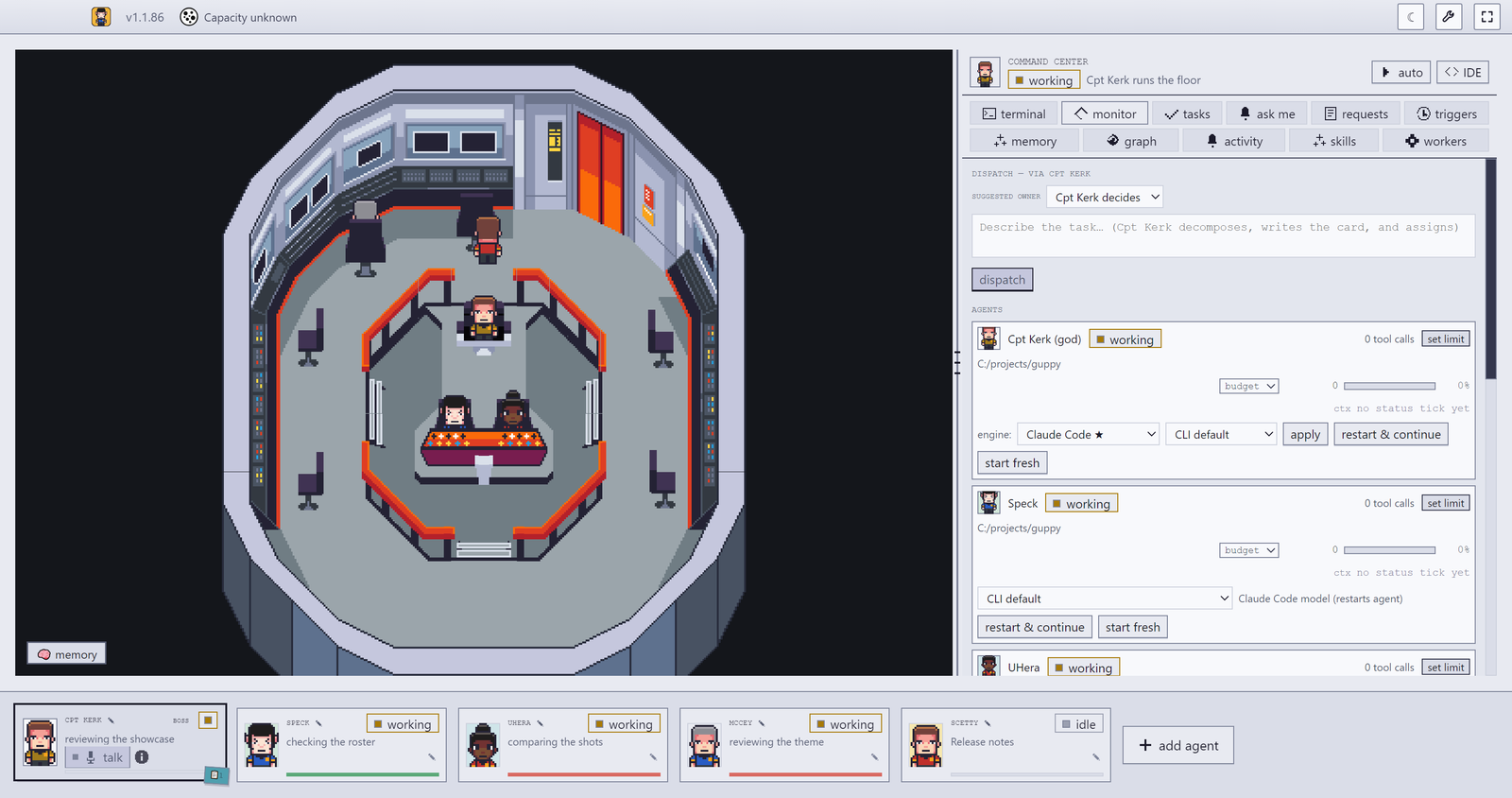
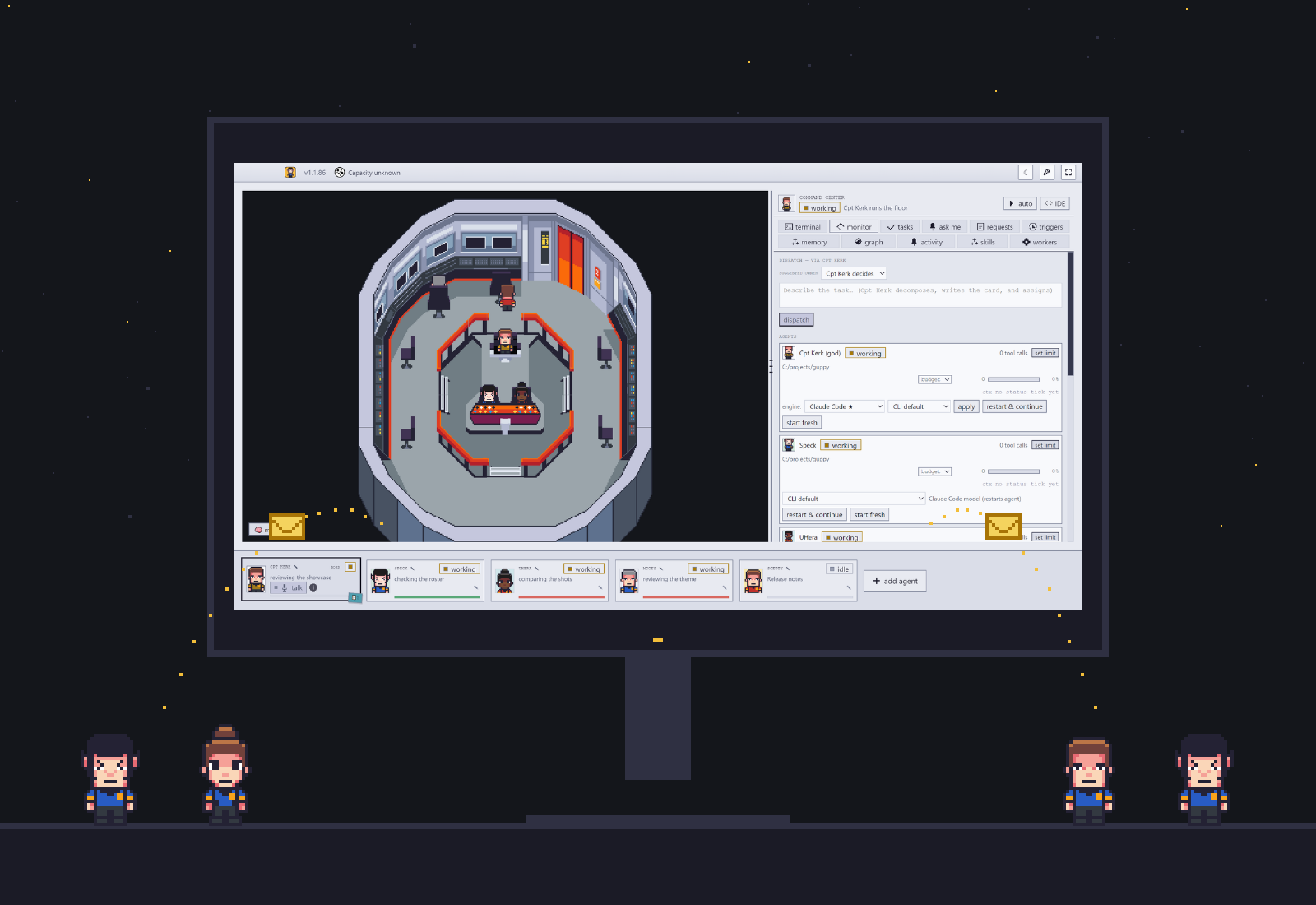
Every terminal is an agent
Guppy wraps real terminal-agent CLIs as fully capable agents.
- Each
claude,agy,codex,grokor custom session runs as a real process in a pseudo-terminal (node-pty), rendered with xterm.js. - Each agent has its own working directory, identity and provider-specific lifecycle.
- Type back into any session, browse its files and read its git history.
Coordination
The hive and the captain
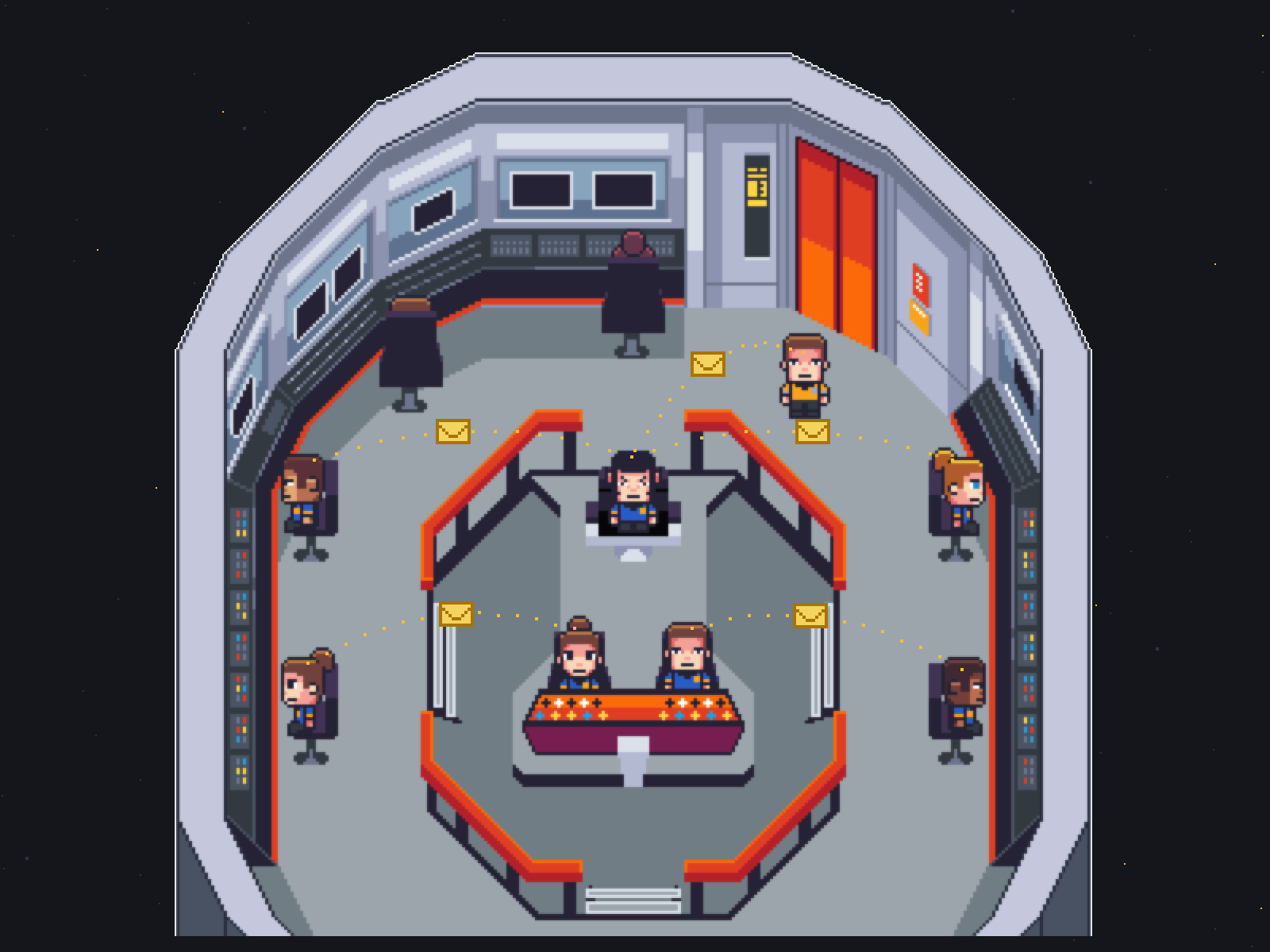
Agents collaborate through the hive, a local folder of plain files. The captain is the one agent you talk to in order to get things done.
- Agents read their memory and get their mail from the app; the router moves messages between inboxes.
- The captain reads every request, resolves routine ones itself and escalates only critical items (spend, destructive operations, scope changes) into an approvals queue.
- Mailbox wakes are delivered directly, so the floor advances without a heartbeat and without you nudging stuck agents.
- The hive is not a git repository; the harness runs no git there.
Memory
Memory that persists
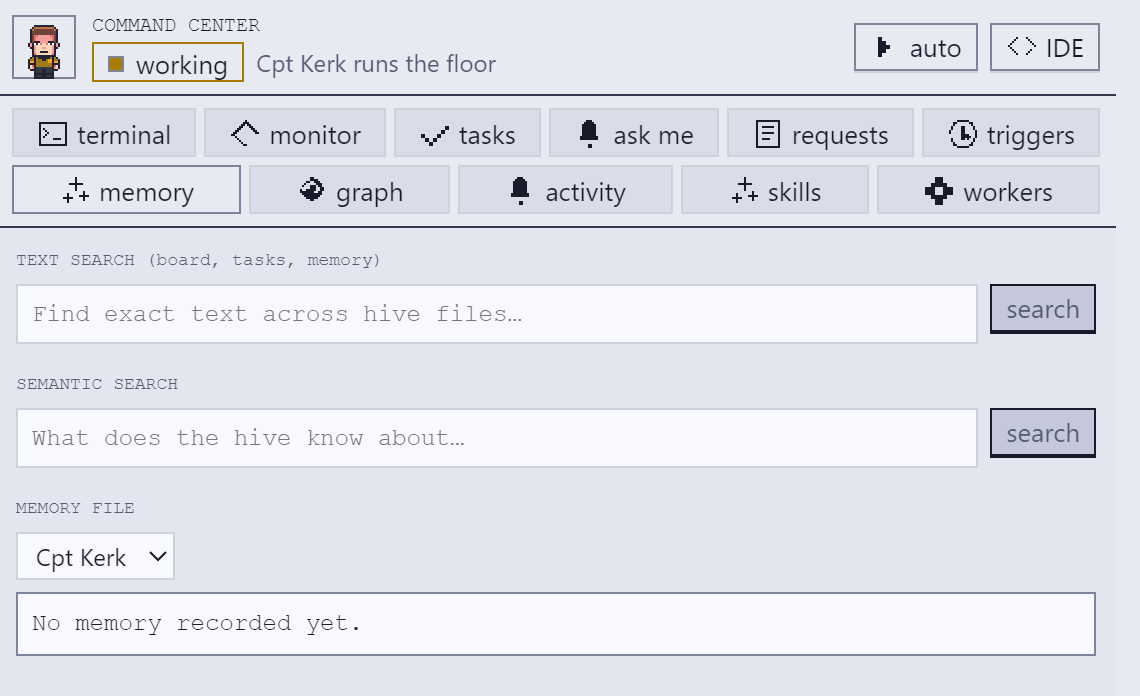
A markdown-first memory layer with semantic recall and automatic condensation.
- Condensation keeps each agent’s memory bounded. On the packaged release gate it condensed a real ~1 MB memory to ~90% smaller in 3 passes, with 0 of 3,781 lines lost.
- The claims ledger is on by default for new floors (1.1.103). If the project folder is a git repo, its commits feed the ledger too.
memory get <key|card-id>returns the current value of a key or card, then the competing and superseded values.memory searchsupports--exactand--newest, and the memory tools are also offered over MCP.
Cost
Spend fewer tokens
The biggest measured waste was spending model turns to discover that nothing had changed.
- A standup with nothing new used to cost ~214k tokens. A locally computed floor-state fingerprint now skips the model entirely when no material input has changed.
- The idle heartbeat ships off by default, with a measured per-setting cost table.
- A capacity seam tracks each provider’s remaining allowance (Claude, Codex, Antigravity) and holds automatic work when it is limited or unknown.
Privacy
Local-only by design
- Agents are local terminal processes; memory, mailboxes, board and log are plain files on your disk, not a hosted service.
- Builds are compiled without the analytics key. Verified on the shipped installer: no client, no install id, nothing sent.
- The auto-updater is pinned to the Guppy repository and is notify-only.
- Background memory condensation runs on your subscription login with API-key variables stripped, so it can’t switch to metered billing.